
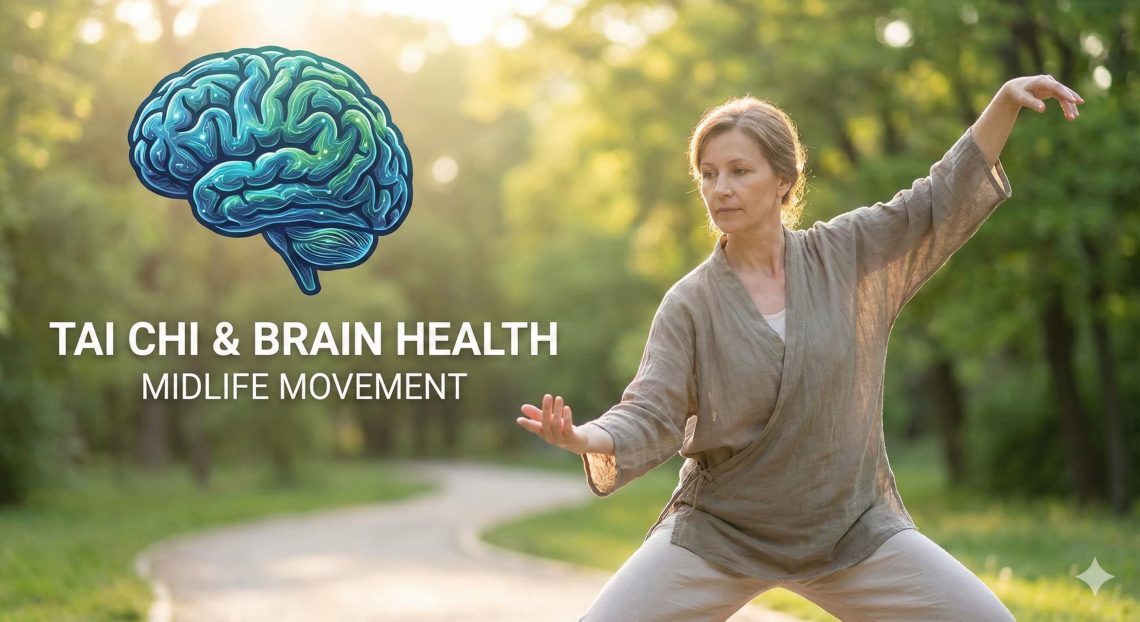
Move Your Body, Nourish Your Mind: Why Midlife Movement Matters for Brain Health
How ancient practices align with modern science on protecting your cognitive future
New research from Boston University has delivered a powerful message about the relationship between movement and mental clarity—one that practitioners of Tai Chi and Qigong have understood intuitively for centuries.
The study, published in JAMA Network Open and tracking over 4,300 people across decades, found that regular physical activity in middle age and beyond can reduce the risk of Alzheimer’s and other dementias by up to 45%. That’s a remarkable figure, and it raises an important question: what kind of movement serves us best as we navigate the second half of life?
The Middle Way of Movement
Here’s what strikes me about this research. The study followed participants through three life stages—early adulthood, middle age, and older adulthood—and found that the protective benefits held strongest when people maintained activity through their middle and later years. This isn’t about punishing gym sessions in your twenties. It’s about sustainable, consistent movement that you can carry with you through life’s seasons.
This is precisely where practices like Tai Chi and Qigong shine.
Unlike high-impact exercise that becomes harder to maintain as joints age and recovery times lengthen, these internal arts grow more accessible with time. The movements are gentle on the body while remaining deeply engaging for the mind. And crucially, they offer something that a treadmill or weight rack cannot: they train the brain and body as one integrated system.
Beyond Exercise: The Mind-Body Connection
When we practise Tai Chi, we’re not simply moving our limbs through space. We’re coordinating breath with movement, maintaining spatial awareness, sequencing complex patterns, and cultivating what the Chinese call yi—intention or focused attention. Every form requires us to remember what comes next while staying present with what’s happening now.
This cognitive engagement may be part of why mind-body practices show such promise for brain health. A growing body of research suggests that Tai Chi specifically offers neuroprotective benefits, with studies pointing to improvements in memory, executive function, and even structural changes in the brain.
The Boston study measured activity levels from sedentary to heavy, but what it couldn’t capture is the quality of movement—whether it nourishes the nervous system or depletes it, whether it cultivates calm focus or simply burns calories.
The Awareness Gap
Perhaps the most sobering finding from the wider research context is this: despite dementia being the leading cause of death in the UK, only one in three people believe the risk can be reduced. And while nearly 60% say brain health matters as much as physical fitness, just 26% take daily action to protect it.
There’s a gap between knowing and doing. And I suspect part of the problem is that “exercise for brain health” sounds like another item on an already overwhelming to-do list.
But what if movement could be something you look forward to? What if it could be a refuge rather than a chore—a practice that leaves you feeling more calm, more centred, more yourself?
This is the invitation of Tai Chi and Qigong. Not exercise as obligation, but movement as medicine. Not another thing to fit in, but a way of being that supports everything else you do.
Starting Where You Are
If you’re reading this in your forties, fifties, sixties, or beyond, the research carries good news: it’s not too late. The protective benefits of movement held across all the later life stages studied. What matters is beginning—and continuing.
You don’t need to be flexible. You don’t need to be fit. You don’t need any special equipment or clothing. You simply need to be willing to show up, to move gently, and to pay attention.
The ancient practitioners who developed these arts didn’t have brain scans or longitudinal studies. But they understood something essential: that the body is not separate from the mind, that movement is not separate from stillness, and that caring for one’s vitality today is an act of kindness toward the person you’ll be tomorrow.
The science is catching up with what the sages knew. Your body and brain are asking for the same thing—consistent, gentle, mindful movement.
The question is simply: will you answer?
Lee Welch has been practicing Tai Chi and Qigong since 2015 and teaches fifteen weekly classes across Buckinghamshire. His approach emphasises presence over perfection, making these ancient arts accessible to people of all ages and abilities. If you’re curious about beginning—or returning to—a movement practice that nourishes both body and mind, you can explore current classes or join the waiting list to be notified when spaces open.

Lee Welch
Lee Welch is an experienced Tai Chi and Qigong instructor. Lee runs Welch Wellbeing, which houses brands like Tai Chi Globe and Inner Kingdom. Specialising in holistic wellbeing, Lee combines the ancient practices of Tai Chi with modern wellbeing techniques to help others cultivate physical health, emotional balance, and mental clarity.

You May Also Like
